Why the Palestinian Authority Might Collapse
And why Israel's far-right wants it to

Saluto,
With the Iran war, Israel’s incursions into Lebanon, and the war in Gaza since 2023, the West Bank has almost been pushed off the radar of international news.
However, that does not mean that drastic things aren’t happening there. One of the notable developments is that the Palestinian Authority (PA), the entity governing parts of the West Bank, is at risk of imminent collapse.
So this newsletter will give you three articles to understand why the situation is getting worse in the West Bank, then explain how a collapse of the PA is in the interest of the Israeli far-right.
But before this, three article to help you make sense of what’s happening.
🗞️ The articles
Chokehold: Countering Israel’s Grip on the West Bank Economy - International Crisis Group
This article is what motivated the topic of this newsletter. It documents how the Israeli government has imposed new economic penalties on the West Bank after the 7th of October 2023. These have choked off the Palestinian Authority’s access to funds and stifled the Palestinian population’s freedom of movement.
Israel’s accelerating de facto annexation of the West Bank has dangerous implications - Chatham House
This articles explains how the expansion of Israeli settlements in the West Bank undermines prospects for long-term regional peace.
This articles shows one example where Israeli politics on the West Bank (a vote at the Knesset) led to tensions between Israel and the current US administration, showing how these domestic political moves can strain the bilateral relationship.
💭 My takeaway: Israel’s policy in the West Bank is increasingly shaped by the far-right
You cannot look at Israel’s actions towards the Palestinian Authority in the West Bank without looking at the aims of the Israeli far-right.
But before we get into those aims, let’s back up a bit and explain what the PA is.
The Palestinian Authority came about after the Oslo Peace Accords (1994), and has been partially governing the West Bank ever since.
Initially thought to be temporary, the PA stayed in place as the peace process stalled and the second intifada started.
Some parts of the West Bank are entirely governed by the PA, others have shared governance with Israeli forces, while other parts are entirely under Israeli control.
That’s what you often see with those maps with the different colours:
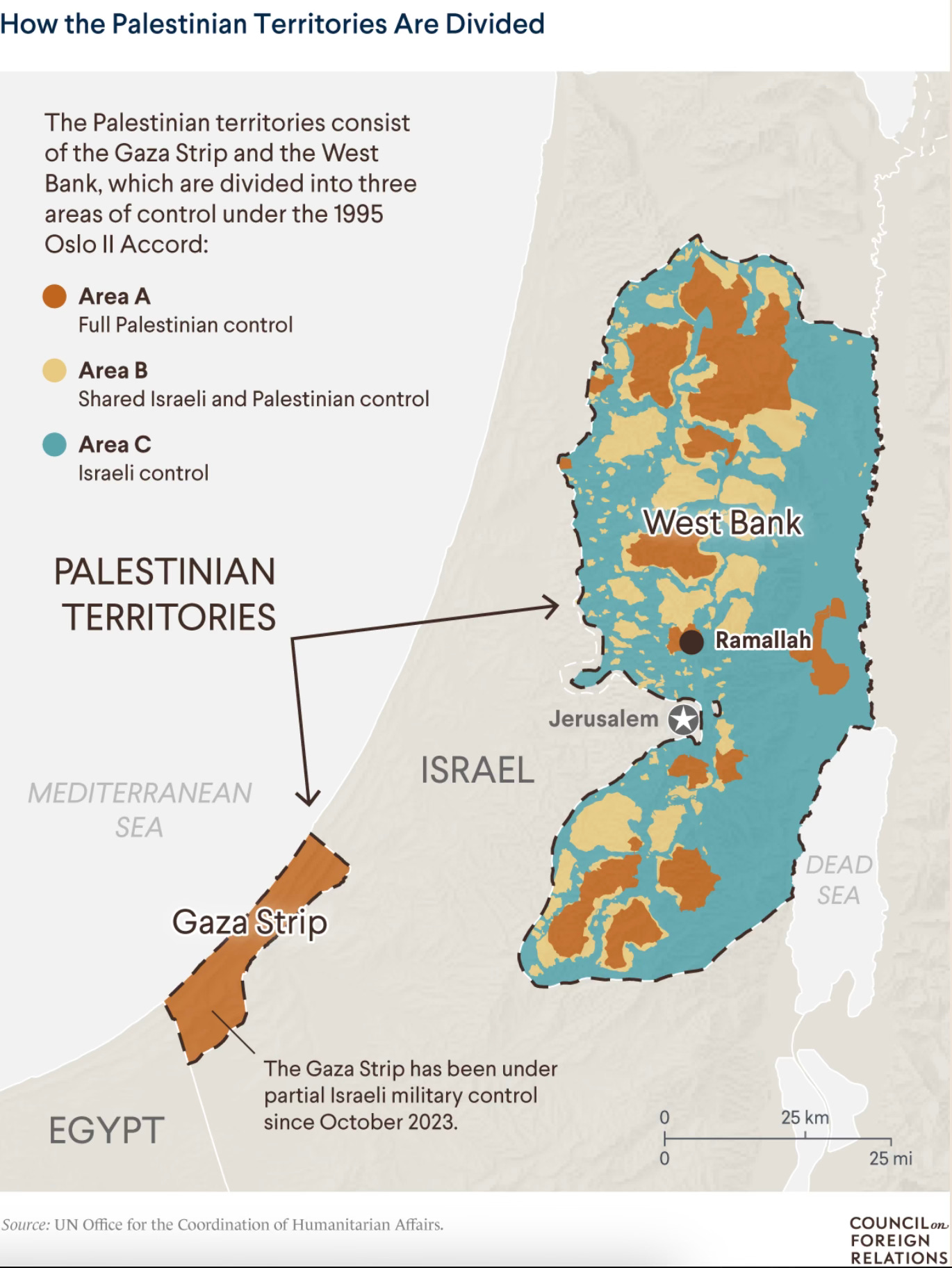
The idea behind this varying level of self-governance was that Israel would gradually give the PA more governing capacity as the peace process of the 90s translated into more peaceful relations between Israelis and Palestinians.
As part of that, Israel also committed to transferring the revenues it collected on goods coming in and out of the West Bank to the PA.
That's the basis.
But peace never fully materialized after the Oslo Accord.
You had the second intifida, then the election of Hamas, all of that would require extensive context, so you can find more information on this historical evolution here.
The point I’m going to make is more on what’s happening now.
Israeli society has been slowly drifting to the right, but this was accelerated after October 7th 2023.
No one represent that growing part of the Israeli society more than Bezalel Smotrich and Itamar Ben-Gvir. Those two are sanctioned by the UK, Norway, Canada, Spain and a host of other nations around the world because of their outrageous ideas and plans for the occupied territories.
Yet they're central to Netanyahu's government, holding two of its most important positions: Smotrich as finance minister, Ben-Gvir as national security minister.
With that power, they're also, in large part, the architects of the policy pushing the West Bank toward collapse: accelerating settlement construction while cutting off the funds Israel is legally obligated to transfer to the Palestinian Authority.
They would say that the collapse of the PA is not their aim. That it’s because of security concerns, the PA's own corruption, and the existence of a martyr’s fund that they are cutting off funds to the PA.
But that's a hard case to make from two men who have repeatedly spoken publicly about "Greater Israel" and annexing the West Bank.
So what’s their end game? Ensuring that no Palestinian statehood is viable.
Gaza, with Hamas degraded and boxed in, no longer offers a realistic path to Palestinian statehood in the traditional sense. But the PA in the West Bank still does, at least on paper.
To be clear, I’m not saying the PA is a good governing entity. It’s a crippled institution, with leaders more interested in enriching themselves than governing. You don’t have to look far to see crazy examples of corruption.
But despite its flaws, the PA remains a realistic avenue toward Palestinian statehood, especially in the eyes of the international community.
If it collapses, or worse, if a group like Hamas were to take control of the West Bank instead, a Palestinian state would become even less feasible than it already is. That’s an outcome (a Palestinian state with a governing entity like Hamas) unacceptable not just to Israelis, but well beyond.
So by withholding funds, allowing settlement expansion to continue, and making daily life harder for ordinary Palestinians in the West Bank, the effect is to make the PA’s task of governing progressively harder. To the point of collapse.
You might ask: why do this? Wouldn’t it increase security risks for Israelis and lead to more instability?
The obvious answer is that chaos works in their favor. It keeps Israel on a path that forecloses any real Palestinian state. For people like Smotrich and Ben-Gvir, a viable two-state solution would be a catastrophe: an obstacle standing between them and what they call “Greater Israel.”
The problem is that if the PA collapses, nobody has an answer for what comes next. Least of all the two men engineering the chaos.
Hope those readings help you make sense of the situation,
Dr Cedric Pfanner
They must,they don't fight against an occupying country why should they have any legitimacy