Why Democracies are losing ground to autocracies?
And what the 'Authoritarian Personality' tells us about it

Saluto,
This newsletter will be about democratic backsliding. It’s the idea that political systems are shifting from democratic to autocratic ones around the world.
More precisely, democratic backsliding is when elected leaders deliberately weaken the institutions that make a democracy work: independent courts, free media, fair elections, civil liberties, and the ability of the opposition to compete.
It’s often slow and carried out by the top.
Here, I’ll first suggest three resources that can help you understand the scale of the issue.
Then I’ll explain what the ‘Authoritarian Personality’ is, which will help you understand why strategies like those of Trump or Orbán work so well with their electoral base.
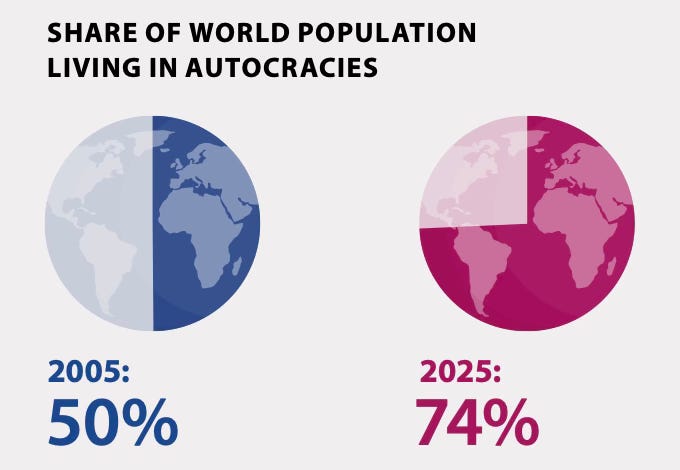
This report gives you all the facts you need to know about democratic backsliding: what counts as “democratic” or “autocratic”, how it’s measured, and what the global trend looks like over the last few decades.
If you’re here from Tiktok, it’s also where I took this graph:
Is democracy doomed? The global fight for our future - Timothy Snyder
This isn’t an article but a TED Talk. Timothy Snyder is a historian with a focus on Central Europe and the Holocaust.
His key point: democracy is not the default setting of the world. It is something that has to be built, maintained, and defended.
If you prefer videos, there is an entire playlist on authoritarianism here.
Social media can support or undermine democracy – it comes down to how it’s designed - The Conversation
This piece shows how the design of social media platforms matters for either strengthening or eroding democracy.
What I found interesting is that it doesn’t view social media as inherently good or bad, but rather that it’s how we build and regulate it that counts.
💭 My take-away: Some people have a tendency to support autocratic leaders.
After the second World War, the Frankfurt School tried to understand why people support dictators and fascist movements.
If you don’t know, the Frankfurt school was a group of authors for whom the works of Freud, Marx, and Hegel were essential to a critique of modern society. Basically, it’s a philosophical and sociological movement spread across many universities.
A key figure was Theodor Adorno, who wrote The Authoritarian Personality to explain people's support for authoritarian figures.
I simplify, but it’s a personality characterised by:
rigid, black-and-white thinking
a jealous preoccupation with social status
an obsession with sexual immorality
a fear of ambiguity
a high value placed on obedience to authority
People high on this disposition tend to want strong leaders who promise order and clarity.
But does that mean they systematically support autocratic leaders? Absolutely not.
There is a second ingredient: a perceived threat.
Ever wondered why Trump, Orban, Putin, and all of those amazing and caring leader keep fabricating enemies?
It does two things:
It keeps a part of the population in a state of fear and anger.
This activates their authoritarian predispositions, so they are more likely to support whoever promises order, strength, and a simple explanation.
You can think of it as activating the lizard brain of people with this ‘Authoritarian Personality’.
Now guess how many apparently have that in the US.
Some surveys suggest that it’s four out of ten. Scary stuff.
💼 So what can be done?
In many countries, politicians have accepted fear-mongering for short-term gains, or used it themselves. That makes the solutions harder, but not impossible.
Individually, authoritarian tendencies can be softened by education, exposure to diversity, and work on fear and ambiguity. Going to therapy actually helps. And don't assume you're immune: since the 1980s, research has shown it's a continuum, not an on/off switch.
Institutionally, backsliding can be resisted by strong courts, free media, fair electoral rules, and party systems that filter out anti-democratic leaders instead of rewarding them.
Politically, we need elites who refuse to normalize permanent enemies, conspiracy thinking, and contempt for democratic rules.
Authoritarian personalities will probably always exist. The question is whether our institutions and political culture reward them or keep them firmly in check.
Happy readings,
Dr. Cedric Pfanner